Monday, July 6, 2020

A TOUR OF THIRLSTANE ON MALDEN HILL


Bar Harbor Record
November 16, 1898


Colonel Morrell's Beautiful Summer Home On Malden Hill

There are now in Bar Harbor nearly three hundred handsome residents built by rich and prominent people from almost every part of the union, who were attracted to the island by the marvelous beauties with which nature with a lavish hand, has endowed it.
The beautiful and costly mansions, styled in the humble vernacular "cottages," are scattered over the narrow plateau or perched amid the foliage on the foothills which lie between the mountains and the bay.
When first the glowing canvas of wandering artists heralded abroad the beautiful scenery of the romantic island and attracted the earlier summer visitors to the shores of Frenchman's Bay, land was cheap and good building sites were numerous.  Hence the first arrivals had a wide domain from which to select, and naturally chose the most picturesque and commanding situations for their summer homes.
The first tracts of land sold to non-residents were those along the storefront facing the bay and the distant ocean.  The restless moods of the ever-changing sea seemed to attract the earlier settlers, and they built their homes within hearing of its murmuring waves.  Then, when the more desirable of these sites were occupied, the next arrivals lifted their gaze  toward the hills over looking the village and found there charming and picturesque spots where the eye  might range over a grand panorama of bay and ocean, mountains and forests.
One of the earliest and most beautiful situated of these mountain eyries, the Thirlstane, built on Malden Hill over-looking Kebo Street by Mrs. Rebecca B. Scott of Washington D.C..  For years the house was occupied by that lady and her son, Mr. Owen Scott.  In the fall of 1897, after the death of Mrs. Scott, the estate was purchased by Col. Edward Morrell of Philadelphia;  and since last spring a crew of carpenters under the charge of A.E. Lawrence, contractor, has been busy making improvements and additions to the old house.
Today, Thirlstane is practically a new house.  A long, two story addition has been built to the kitchen wing.  the entrance hall and dinning room have been greatly enlarged and entirely remodeled;  and a wing forty feet in length has been built on the south end and finished for a study and library.  the piazza on the east front has been rebuilt and lengthened to cover the additions on each wing.  At the southwest corner a very handsome flight of granite steps connects this piazza with the garden in front of the house;  and a stone terrace with tiled floor has been built out over the brow of the hill on the northeast corner.
It is in the decoration and finish of the public rooms at Thirlstane, however, that the most wonderful transformation has been wrought.  All that art could desire and skill effect has been employed to render these apartments pleasing to the eye and convenient for the purposes for which they will be used.
The main hall extends across the entire width of the house, with windows on the east side overlooking the village and the bay, and a door opening on the piazza.  The original length of the hall has been much increased on the northern end and the apartment has now the dimensions of an old baronial hall.
The hall is entered from the west by double doors, with panels of leaded glass in beautiful floral designs of a golden amber tint.  On either side the doors are windows of the same design.  The wainscoting is of panel work;  and the walls and ceilings are plastered and tinted a rich warm green.  A large open fireplace surrounded by a handsome mantel make the dining room as it should be, the brightest room in the house.  A wide door, with plate glass panels gives access to the porch on the eastern side.  The floor, like that of the hall, is of quartered oak.
But the masterpiece of workmanship and art at Thirlatane, is the study, which formsm the new southern wing of the house.  Entering it, the visitor seems to leave this place and century, and find himself in some old english manor house of the Elizabethan period.
Every bit of woodwork in the room is oak.  The floor is of the most beautifully figured quartered oak;  the beams and rafters in the roof are of oak;  and the window seats, the book cases, and the settle by the fireplace all are oak.
A flight of three steps under a wide archway lead down from the parlor to this room which has a length of nearly forty feet and a width of twenty feet.  The oak panelled are eight and a half feet in heigth and are intersected by double casement windows of leaded glass, the architraves between them beautifully decoratecd with carved work.
The oak beams and rafters in the roof form panels which are filled in with plaster work.  The walls are surmounted by a carved frieze in sections four feet in length between the ends of the rafters.  three grinning faces, hideous dwarfs, and creatures of bygone ages, look down on the visitor from every corner;  and add to the antiquated style of the room.
In the eastern wall is an immerse fireplace, 4 x 6 feet in the open.  The face is built of Indiana limestone and the hearth is a single flagstone.  Stone corbels grin on either corner.  The heavy mantel twelve feet in length, is beautifully carved from one solid piece of oak.
All the fine carvings in this room were done by the boys of industrial school, Philadelphia.  The handsome oak paneling was also made in that city.  The work of building this wing, however, and fitting and putting the material together was all done under the superintenence of the contractor, Mr. A.E. Lawrence;  and this as well as the work in all other parts of the house, speaks well of his skill and good judgement.  The architects were Messrs Cope & Stewardson of Philadelphia, and Messrs Savage & Straton supervised the work as their local agents.
Modern plumbing of the latest mode and design has been introduced through out the house, Messrs Leighton Davenport & Co. doing the work.  The plumbing in the Butlers pantry is as fine a job of work as was ever done in town.  The double sink and long drain board and back, of fine German silver, is a beautiful and costly piece of workmanship.  The painting through out the house has been done by Graham & Tabbutt and shows both taste and skill.  The handsome stonework was built by George L. Wescott.
With its alterations and improvements Thirlstane is now one of the handsomest residences in Bar Harbor;  while its commanding situation gives its owners as fine a view as this beautiful region affords.


Thursday, June 18, 2020

SIEUR DE MONTS SPRING - A WONDER OF NATURE OR MAN MADE

ACADIA NATIONAL PARK

BAR HARBOR TIMES
JULY 21, 1960

To the Editor;
Visitors at Sieur de Monts Spring may at times wonder about the early history.  One standing on the large flat rock in the brook and watching the water bubble and gorgie from beneath it may think he is beholding a natural event, when in fact, he is looking at the result of human planning and effort.
In the summer of 1907 John Prescott, owner of the property developed the spring at the upper end of the Harding Farm, so called, which was originally known as Red Rock Spring, and later, Mt. Kebo Spring, undertook to do the same thing with what is now the Sieur de Monts Spring.
I learned this quite by accident.  One day in the summer above mentioned I was walking with a friend of my parents through the woods in that section.  As a boy I had fished in the brook that flowed out of the meadow - now known as the tarn - and I knew that area very well.
Near the brook at that time was a small boiling spring with a much larger one several yards away.
As we came into the path off the Seal Harbor Road we heard from the valley below us the sound of horses and a stone drag.  Coming into the clearing at the foot of the hill we found Mr Prescott with a team of horses dragging a large flat rock towards the smaller spring, and learned that he was planning another bottling plant similar to the one at Red Rock (Mt. Kebo).  He told us he was setting that flat rock over the smaller spring in the attempt to force the water back into the larger one which he planned to deepen and enlarge.
The bottling plant, as such, did not prove to be the success had hoped, and in course of time the property passed to other hands and now has been developed into the beauty spot we have today.  But that rock is the same one we saw put in place over 50 years ago.
What we see today is not a freak of nature but a deliberate attempt to improve on what nature has provided.
I can vouch for this as I am the only living person who was present when that stone was set in its present position.
Sincerely,
Rev. Charles S. Mitchell, DD

SIEUR DE MONTS SPRING HOUSE
ACADIA NATIONAL PARK


WHO WAS THE REV CHARLES S. MITCHELL

A piece I found in an article in the Bar Harbor Times dated August 2, 1922 states in part;
"Mr. Charles S. Mitchell served Long Island till cold weather, than he moved his family to Bar Harbor and spent the winter assisting in special services at Cranberry Isles, Matinitus, and other places.  It seemed best to locate Mr. Mitchell at Corea where he can be of help in the town of Gouldboro, as there is not a minister in the town."
In the December 6, 1922 Bar Harbor Times, upon the passing of Rev. A.P. MacDonald, who had been the head of the Sea Coast Mission. A piece in that same paper was written by the Rev. Charles S. Mitchell, whose title states the following;
"Rev. A.P. MacDonald;  A word of appreciation by Rev. Charles S. Mitchell, who was for some time associated with Mr. MacDonald as Assistant Missionary."
In a copy of the Bar Harbor Times dated July 26, 1922 an article begins with the following;
"BAR HARBOR MAN IS ORDAINED AT COREA
Charles S. Mitchell after service in Sea Coast Mission is now Baptist Minister.
A council of churches of Hancock County, was called by the church at Corea Wednesday, July 19th, to set apart by ordination to the Baptist ministry, Charles S. Mitchell who has been serving this church for the past two months, after nearly two years in the Sea Coast Mission work."
An article from the Bar Harbor Times in 1915 states that "Charles S. Mitchell expects to enter Gordon Theological School in Boston the middle of next  month."

Red Rock Spring
Bar Harbor


Doyles Market, School Street
Bar Harbor


Lafayette Cafe - Main Street
Bar Harbor

THE ODD COTTAGE OF MALDEN HILL

Bar Harbor Mount Desert Herald
Feb. 15, 1883

Perched on the ridge of Malden Hill, to the southward of Mrs. Scott's house, is a pretty but odd looking cottage with a tower on its southern corner.  It is the property of Col. Francis W. Lawrence of Brookline, Mass..  To approach it we take the hill on the right of Kebo Street, opposite St. Silvia's Church, and follow the road until we come to a driveway which leads us directly to the end of the piazza, on the western side of the building.
We enter the house from this side through a Dutch doorway which opens into a vestibule 20 by 8 feet.  To the left are the kitchen, china closet, pantry and laundry, and a little room which is termed 'the den,'  probably the owners study.  On the right, at the other end of the vestibule, is an octagon-shaped parlor and, opening off it, is the dining room.  The floors of these rooms are bordered with ash the center being white pine. Curtains are to be used in them in place of doors and the mantel-pieces extend from floor to ceiling.  The cornice of the parlor is very peculiar, consisting of a breadth of about nine inches of rough plaster set with mussel shells, with a gilded molding below.
In the vestibule opposite the main door is the entrance to the structure, a beautiful piece of trellis-work.  A peculiarity, of which we will see more further on, begins to show itself here.  Some of the woodwork has been left rough just as it came from the saw, and bordered with molding of the most exquisite finish, apparently to show the contrast between the coarse and the fine arts.  In a niche which opens from the staircase into the dining room, we notice what at first sight seems to be the end of a flight of stairs, but on closer inspection turns out to be only a set of brackets over the side-board in the dining room.
At the head of the stairs, on the second story, are the parlor-chamber and a chamber over the dining room, each with a fine dressing room attached.  Off this story is a balcony 22 by 6 feet.  Off the hall are the servants quarters, linen closet and a large bath room.
In the third story are two rough chambers and a chamber in the tower over the parlor chamber in the second story.  This chamber is lighted by two large oval windows, one looking on the water and the other toward the mountains.  A Bannister of carved work surrounds the head of the stairs, and on one side are large water tanks with a capacity for about 1500 gallons, surrounded by a row of seven small round windows, somewhat resembling the dead lights of a vessel.  The woodwork and rafters on the inside of the roof have been left in their rough state and stained, making the same contrast with the Bannister as we remarked on the ground floor.
From the third story we reach the top chamber of the tower by a curious little flight of outside stairs.  This chamber is an octagon with a diameter of twenty feet and lighted by fourteen windows, about two feet square.  Each window consists of nine panes and when open can be let down out of sight.  The woodwork in this room is also rough and stained, and a hook is set in the centre of the room from which to suspend a large lantern.  When this is lighted at night it will give the tower the appearance of a large light-house.  The room will be very convenient for a billiard hall and may, perhaps, be used as such.  The extreme height of the tower is 65 feet, and it commands a magnificent view not only of the sea but of the mountains.  In fact the view of The Gorge and its surroundings is the finest to be obtained in Bar Harbor.
A piazza 103 feet long by 12 feet in width surrounds the entire main part of the house;  the halustrade around it is made in basketwork panels.  These large French windows open on it and are so placed that with curtains on the piazza, the whole space;  including parlor and dining room can be converted into one large reception room.
The house is built on the ledge and supported with heavy brick piers.  The cellar is lighted by seven large windows and contains an ice room, wine closet and coal bin.  The woodwork throughout is of choice selection and beautifully finished;  and that which has been purposely left in its rough state only enhances the appearance of the remainder.  Messrs, Rotch, and Tilden of Boston are the architects, and Mr. George Barron the contractor, and though this is by no means such a large undertaking as Mrs Bowler's residence, yet it speaks volumes for their combined skill.


Malden Hill - also known as Scott's Hill, Hamilton Hill, and Schoolhouse Hill.


Ash's Stable - Mount Desert Street
Bar Harbor


M.F. Richards Horse Shoer
Cottage Street, Bar Harbor


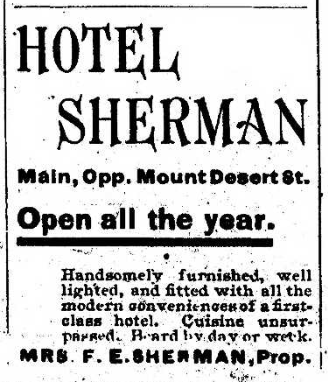
Hotel Sherman
Mount Desert Street Bar Harbor


Mayo's Ice Cream Parlor
Southwest Harbor Maine


STATUE OF LIBERTY KILLING OUR BIRDS

STATUE  OF  LIBERTY  KILLING  OUR  BIRDS

Mount Desert Herald
September 30,  1887

The Statue Of Liberty in New York Harbor is responsible for the daily slaughter of immense numbers of little birds which in winging their way south on their annual migration, are attracted by the brilliant electric light of the big torch.  On one morning recently no less then 1500 of the poor creatures were picked up and their condition indicated that they had dashed themselves against Liberty;s bronze bosom and had been thrown crushed and lifeless at her feet.


WHEN IS AN AUTOMOBILE NOT AN AUTOMOBILE

BAR HARBOR'S FIRST AUTO

Bar Harbor Record
August 7,  1907

INTRODUCTION
As far as I can tell, this newspaper article appears to be about the first car in Bar Harbor that violated the "No Auto's" law, where a few roads you could drive a car on, most roads cars were prohibited from driving on.  I found the argument the guys lawyer put forward to be an interesting defense, "When is a car not a car,"  an article well worth the read.

OWNER ARRESTED SUNDAY, FINED MONDAY
Story of the arrest and trial, with arguments of Counsel/

Mr. Fordham C. Mahony, of New York, was arrested Sunday night in front of the Belmont Hotel, by Chief of Police Guthrie charged with running his automobile over one of the town of Eden's prohibited roads.  The case came up in the municipal court Monday morning and was adjoined until 2 o'clock.  After a three hours trial Judge Clark adjudged Mr. Mahony technically guilty and imposed a nominal fine of $1 and costs.  Mr. Mahony did not appeal and paid the fine and costs, amounting to $17.09.
The case was the first under the prohibitory ordinance, passed by the town under the enabling act of the legislature,  and of course excited endless comment and judging by street and curb and ship talk endless interest.  Mr. and Mrs. Fordham C. Mahony are on their wedding trip, en-auto, and left New Your City a week ago Tuesday.  Mr. I.R. Grossmann, a season guest at the Belmont, is the defendant's fath in law, and is also brother of Mrs. Frank Fremont Smith.  Mr. Mahony is grandson of the celebrated author, J. Fenimore Cooper.  The wedding tour went merry as a marriage bell until Corkscrew Hill was encounter in the town of Eden with legalism and lawyers on the thitherward side.  In Camden the bridegroom became acquainted with Harry R. Willey, who who put him "Wise."  Willey said to Mahony that he was "next" to things upin Eden, and if he wanted to run his bloomin devil-car into and through the roads of the proud metropolis of Mt. Desert there "was a way" as Sentimental Tommy would have put it, courts and counsel not withstanding.  Willey's eloquence seemed conclusive, and the trick, not half bad for a wedding tripper.  But with his brakes burned out and his honeymoon interrupted, Mahony  came to full stop in front of Judge Clark on Monday.  The case was fairly tried, and Judge Clark's Summing up was an admirable bit of judicial charity and sense.  A few facetious passages between counsel lightened up the dry tortuosites of the law to the lately.  The court room was jammed, and ladies stood from two to five o'clock when the case was ended.  Among those present  were Mr. I.R. Grossmann, Mr. Arthur D. Additson, Mr. E.B. Mears, Mr. F.L. Savage, Mr. L.E. Opdycke, president of the V.I.A., Mr. Ed Bunker, the town's first selectman for many years, Mr. B.S. Higgins, the present First Selectman, Mr. Max Franklin, Mr. J.P. Bass, owner of the Bangor Commercial, and Mr. Fred C. Lynam, of the Bar Harbor Banking and Trust Co.  E.S. Clark, Esq., conducted the prosecution, and Mr. Mohony had as counsel Elliott N. Benson, Esq..
Mr. Clark opened the case and said Attorney Wood had been out of town and had not had sufficient time to become conversant with it.  He explained that the prosecution was one to test the law, and was made in the name of the town, the chief selectman having ordered the chief of police to start the prosecution.  Mr. Clark said  that about half past six that Saturday night the defendant, with his wife and his chauffeur, Mr. Austin N. Hopey Jr., together with h.R. Willey where on the further side of Corkscrew Hill, on the Bay Shore Drive.  Power was shut off and a horse hitched to the auto and the machine pulled up to the top of the hill.  It did not come out in testimony but it is common talk about the town that the noble friend of man in question did not have "pull" enough to drag the motor car, a heavy Oldsmobile, to the top of the hill.  so the chauffeur turned on the juice, which nearly scared the horses to death, and sent him up the hill at a gait he never before and probably never again will hit.  The crest of the hill gained the car and its passengers came down unassisted, except by gravitation, and the strong push and the long push and the push altogether of Mr. Willey, Mrs. Mahony aboard and the bridegroom at the steering wheel.  A great deal was made in taking testimony of those two facts, it being contended by the prosecution that to all intents and purposes the auto was being "used" on one of the townships roads.
Five witnesses for the town were sworn;  Chief Guthrie, William H. Sweet, William H. Sherman, Frank E. Elliot and Oliver Hall.  Mr. Sherman, as town clerk of Eden, read the warrant, attest, and the town vote taken on Article 2 of the warrant July 1st, 1903, defining certain roads prohibited as concerned auto travel.  Mr. Oliver Hall, testified that defendant had said Sunday night that he had the "National Association" behind him and that there would be plenty of automobiles here another season as the Gilden Tour was planning on coming to Bar Harbor in 1908.
Testimony was introduced as to the place and visibility of the signs, and the size of the lettering, warning autos off the roads in question.
The following definition was given a legal status, "An automobile is any vehicle driven by its own power contained within itself."  Attorney Benson started in to conduct the case for the defendant by saying that when he became aware of the alleged violation of the town's auto prohibition laws he received the impression that some great dragon had come to town with burning eyes and flashing tail, and that the people of Bar Harbor had perhaps fled to their houses and barred themselves in.  Instead, however, a gentleman from New York had, without breaking any laws of state or town, come to town in a motor-car.  He had tried to get into Bar Harbor legally, and to this end had got a horse (the same horse that was thrown into a state of chronic neurasthenia by his experience, according to current rumor - though defendants attorney did not introduce this into the testimony) and had his auto hauled onto an un-prohibited road.  "We claim," said Mr. Benson, "That the moment an auto is not under its own power, but pushed or pulled by other power, it is a piece of merchandise.  Mr. Mahony does not represent the world trying to break into this stone wall of exclusion, hedging this town about."
On oath Mr. Mahony testified that he had no interest in the make of car he operated, or the manufacturers, or in any car or firm whatever, and that he did not come to town to violate any law, or to make a test case.
Austin N. Hopey Jr., Mr. Mahony's chauffeur, proved a clear minded witness who expressed with vigor and piquancy his testimony.  It was impossible to corner him.  Asked concerning the stopping of the motor when descending hills Mr. Hopey created a smile by saying, "from the time we start on a journey till we get to the end we don't shut off power unless we stop to get something to eat."
In his summing up argument for Mr. Mahony, Mr. Benson said, "There is a  disposition, I can read it n faces as I go about, I can read it on faces here to discriminate and take away the Inallenable rights of citizens.  Here is this gentleman from New York, watched and hounded and grabbed up like a dog - Sunday night - they couldn't wait until Monday.  Ocean Drive and the Bay View Drive are perhaps specially dangerous for automobiles to operate, but our case has to do with two little ends of the Corkscrew Hill Road.  Being drawn by a horse, or pushed by men, she's no longer an automobile, but an article of merchandise, the same as a carriage being towed.  She's no longer an automobile but a piece of merchandise.  She was in the act of being transported.  Your Honor, I assure you that this will be no test case.  I want to inform this court and the public through the court that if there are any timid souls who are afraid the automobiles will be going around frightening their hens, or pigs, that this auto-prohibitory law  is not worth the paper it is written on.  That law is absolutely unconstitutional  when it closes every road to the people of this country.  This is a little bit of petty case, but we shall need the motor bicycles and the automobiles to keep the grass down and out of our streets if this sort of temper of mind is carried out.  I deny the constitutionality of the law,  and in the second place there was no ordinance of the town of Eden violated as this automobile was not running under its own power when upon the prohibitive bits of road in question.
  Mr. Clark in  his closing argument for the prosecution was clear and strong and convincing.  He said here is a gentleman who travels clear from New Your to Duck Brook Bridge in his automobile.  Up to that point there is no question but that the machine is an automobile.  Query;  is it still an automobile when it goes over the hill?  Is it  still an automobile when it comes out on the other side?  Three minutes before it was an automobile, three minutes afterwards it blooms out into an automobile that runs over people.  The question is was he using it as an automobile when he passed over the forbidden pieces of road.  Whatever it may of been, weather an automobile or moth, or a butterfly, he was using it.  He used it for the conveyance of himself, and at least his wife, over the Duck Brook Road.  I will be sorry if the grass grows in the streets of Bar Harbor, and I am sorry that my brother lawyer alluded to the "unpopularity" of this law.  The law was voted twice by large majorities.  There was no question as to the count.  I am sure that the people of this town rather have the grass grow here than see automobiles come here and run over our women and children.  This prosecution is brought to secure our legal rights, not in a vindictive manner, but as an example to the world that the laws of Eden cannot be violated with immunity; that the laws of Eden which have been put upon the statue books must be respected."
The case was here left to the court and Judge Clark summed up as follows;  The case before the court is not the wisdom or the unwisdom of the town in seeing fit to avail itself of the legislative act concerning automobile prohibition.  Neither has the defendant committed a crime, only a misdemeanor;  it is purely statutory.  The question of intent does not concern us.  It is purely a question of what the defendant did, regardless of intent.  The question is, were you not using an automobile in this restricted territory.  The word automobile applies to all vehicles propelled by power.  The apprehended danger to carriages was the reason for the passing of this act.  I think technically that you have violated


JUDGE DECIDES IN FAVOR OF BAR HARBOR WATER COMPANY

JUDGE DECIDES IN FAVOR OF BAR HARBOR WATER COMPANY

Bar Harbor Record
January 11, 1899

The following rescript in a case which is of interest to Bar Harbor people, has been received from the law court.
Hancock County;  Elihu T. Hamor vs. The Bar Harbor Water Company.  Re script by Haskell J.
The Bar Harbor Water Company was authorized to take water from Eagle lake, which is eminent domain, for domestic purposes.  The company by regular procedure took the water by means of a 24 inch pipe and paid damages for the same.
The plantiff is the tenant of a mill on Duck Brook, an outlet of the lake.  His rights are those of a riparian owner, entitled to the regular flow of the stream.
It does not concern him that the water company may of used the water taken from the lake for purposes unauthorized by its charter, so long as it does not take an excess of what it was authorized to take.
This is a consideration for the public, and not for the individual.  It makes no difference to him what use may be made of the water taken.  He can only be concerned in the measure taken.
The water company became the lawful owner of the dam at the outlet of the lake, which it was authorized by the legislature to maintain, so as to increase the water supply.
The plaintiff claims an easement in this dam by which he may regulate the flow of water to his mill.  The evidence fails to show such easement and if it did, it was extinguished by procedure in condemning the dam and land where damages were paid to all owners therein.
The water company have maintained at the outlet a solid stone dam that raises the water some three feet, and the plaintiff complains that he is thereby deprived of the water to which he is entitled at his mill;  but he is not.


He is entitled to the natural flow of the stream and the volume is substantially the same with the dam as without it,  inasmuch as it does not divert the water through any other outlet.
The regular flow may not serve him when an intermittent flow, regulated by gates, might, but he is not entitled to have.  If he wants an intermittent flow he must gain it by means of a dam of his own, not by the dam of another.  He has no cause of action.
Judgement for the defendant.
The suit was brought by Elihu T. Hamor against the Bar Harbor Water Company to recover damages for diverson of water.  John A. Peters Jr. of Ellsworth was consel for Mr. Hamor, and L.H. Deasy, for the water company.

THE EAGLE LAKE DAM - BAR HARBOR

NEW EAGLE LAKE DAM

October 23, 1895
Bar Harbor Record

Water Company to Build New One At Eagle Lake

The Bar Harbor Water Company has submitted plans to contractors for estimats for its building of a new dam at Eagle Lake, 400 feet in length, to suppliment the present dam, which has become too small for th growing necessities of the population of Bar Harbor.  The necessity of a larger dam in order to retain in greater quanity of water as well as to prevent leakage, has been patent to the officiers of the company for some time, and at a recent meeting it was decided to build the proposed dam in this fall.  It is their intention to begin work as soon as the proper bid for the work has been made.
If the weather is favorable they intend to have the dam completed before the winter sets in.  Civil Engineer Freeman C. Coffin, of Boston, who drew the plans to this new dam roughly estimates that from May to October the loss of water by evaporation, in Eagle Lake, is fifteen ibches.  The average daily consumption for Bar Harbor is about a million gallons, which with the evaporation would reduce the water in the lake about 24 inches, from May to October.
A measurement of the water to Eagle Lake this fall, showed that the lake had fallen 4 feet 8 inches during the summer.  Thus, deducting the average evaporation and consumption, it will be seen that there has been over two feet leakage.  It is as much to prevent this leakage as to retain more water, that the company proposes to build the dam.
The new dam will be built about 40 feet inside the present structure, and will extend 400 feet in length, with a water-way in the center and with an average heigth of six feet, and width of three feet.  There will be an embankment of earth on each side and covering the top.  The base will be forty feet wide and the top about twelve.  The inner slope of the dam will be covered with six inches of broken stone, and above this will be a layer of paving.  Should the water in the lake rise too fast to prevent work, or should the weather prove too unfavorable, the work will not be started until next fall.
Besides this, the company proposes to lay a line of eight inch pipe to Hulls Cove, from Eden Street, a distance of nearly three miles.  This work will be begun about the same time as the dam with the hope of finishing it before the cold weather sets in.  The building of the costly summer residences at Hulls Cove, and the tendency to build in that direction  has enduced the company to build in that direction has enduced the company to make this outlay at this time.
The Bar Harbor Water Company is to be congradulated for its enterprise and progress in these local improvements.  Bar Harbor has already one of the finest water systems in the state, considering the population, and this addition will make it bigger and better then ever.


NOTE;  one of the interesting things I learned from researching the building of this dam was that before the dam was built, Eagle Lake had a nice sand beach.  When the water level rose from the new dam the beach ended up under water as the size of the lake was increased, which resulted in law suits, one below was filed by Mary Curran over the loss of land by the enlarging of the lake.


LEGAL NOTICE
Mary Curran
April 7, 1897
Bar Harbor Record

On this date a Legal Notice was placed in the paper stating that Mary Curran was seeking damages for loss of property as a result of the Bar Harbor Water Company building a dam on Eagle Lake, which resulted in the rise of the water level of the lake, which resulted in her lossing a good size section of land.  It states that because neither Mary Curran nor the Bar Harbor Water Company could not come to an agreement as to what her damages was, a judge was being asked to step in and come up with an amount which she should be paid.  The land in question was the site of Curran House, the property left to her by the death of her hsband, Nick Curran.


Below is a second Legal Notice which appeared right below the above the top notice, but much easier to read so I am posting it in two parts as it appeared in the paper;