Thursday, June 18, 2020

PLANE CRASH LANDS AT KEBO VALLEY GOLF COURSE

According to the Maine aviation Historical Society, a twin engine USAAF B-18 Bolo bomber made an emergency landing in Poland Springs on July 19, 1941 and later a RCAF Avro Anson made an emergency landing on the Kebo Golf Course's fairway in Bar harbor Maine on Oct. 24, 1941.
On Feb. 5, 2018 the Ellsworth American Newspaper ran a piece on the anniversary of the plane crash at Kebo Golf Course. The crash took place just weeks before the United States entered World War 2. It was a stormy night when the plane went down and at least one person thought we might be under attack by the Nazis as phone calls began to flood in to the Bar Harbor Police Station. Besides the sounds of the large aircraft circling low over the town, the glow of flares dropped by the plane lended an eerie feel to the scene unfolding that night. Some of the flares drifted on toward the Shore Path and the waters of Frenchman's bay.
Earlier in the day the aircraft departed its base at Pennfield Ridge in New Brunswick as it set off on a routine training mission. By late that evening the plane had found itself in bad weather, lost in fog and ice forming on its wings. The use of flares was the only way the crew could desperately search out a safe place to put the plane down. Out of gas and time, the plane banked hard and crash landed at the 535-yard, par 5, 14th hole at Kebo Valley Golf Club just west of town. The belly landing left the plane intact with bend propeller blades as the plane skidded some 600 feet before coming to rest in a sand trap.
This crash could of been a lot worse had the plane broken up or caught fire.

I can't recall exactly how many men made up the crew but I believe another piece I read on this stated their was either a five or seven man crew on the aircraft that day, and not one of them was injured.


THE ELLSWORTH AMERICAN ARTICLE

CHANGES IN BAR HARBOR DURING A QUARTER OF A CENTURY 1879 - 1904

CHANGES IN BAR HARBOR DURING A QUARTER OF A CENTURY  1879 - 1904

Bar Harbor Record
by George H. Grant

The rapid growth of Bar Harbor, Mt. Desert Island, for the last few years, calls in mind some of the early experiences, while in business there.
In the spring of 1879 I went from Rockport to Bar Harbor on the little steamer May field;  a most beautiful sail but an all day trip.  This boat and the steamer Lewiston, each making two trips per week, where the only means of reaching Bar Harbor except by stage drive from Bangor, a distance of about fifty miles.
My employment at that time being telegraph operator, my first office was a small room in the basement of the old Agamont house, that was soon let for fruit business.  No telegraph communication had been at Bar Harbor since the season before.  About July 1st, my office was moved into an adjoining room which was occupied as a meat market - the telegraph instruments being set up on a meat bench and this was the only office used until late July, when a new office which cost $1`50,00 was built across the street.  This seemed quite palatial when compared with the meat market.
Very few summer people came to Bar Harbor then until after July 4th, and all went away by the 5th of September.
During the fall, deciding to stay in Bar Harbor through the winter and having had a few weeks experience in the meat market, I arranged with Mr. H.C. Sproul to manage his small market and keep the telegraph office open.  This was the first winter of any communication by wire with the outside world.  At that time it cost $1.05 to send a ten word message to Boston.  Afterwards the rate was reduced to eighty cents and later to twenty-five cents.
There was some building during that winter, which made it necessary for workmen to come in from outside and we all boarded at what was then the Exchange Hotel, situated on Mt. Desert Street, near the present Ledgelawn Avenue.  This house was kept by Mrs. Willard Higgins and was the only winter hotel in town.  It was a truffle cool for us that winter there being, aside from the kitchen stove, only a small air-tight in one room, which was suppose to warm the whole house.  This was quite different from the present conditions, when you hear the boarders complain because every room is not steam heated.
In the spring of 1880 I became interested in the purchase of the telegraph line then running from Bar Harbor to Southwest harbor, connected there with another telegraph line running from Southwest Harbor to Ellsworth.  Thus Bar Harbor business all had to go through Southwest Harbor office, than to Ellsworth, where it was repeated over the direct lines of the Western Union Telegraph Company.
In the spring of 1881, by the advice of Dr. Robert Amory, who had decided to have telephone communications with his summer residence and the St. Sauveur Hotel, I decided to go into the telephone business.  During that summer there were five telephones in service, making the first exchange at Bar Harbor.  The switchboard was about fourteen inches wide by eighteen inches high, this being considered quite an innovation.  Last summer there were about 450 telephones in Bar Harbor alone.


In 1883, feeling the need of better telegraph facilities, we built a new line from Bar Harbor direct to Ellsworth.  But the Western Union then would not allow us to connect our line with theirs, saying they had decided to build themselves, and thus tried to crowd us out - another case of the big fish eating the little ones.  At this time we decided to use the new line, spoken of above as being built for telegraphic purposes, for a telephone line and in August 1883 an exchange was opened in Ellsworth with a few subscribers.  Later branches were built to Seal and Northeast Harbors, Lamoine, Franklin, Hancock and Sullivan.  This business increased rapidly until 1891 when it became necessary, from lack of capital, to sell at a great sacrifice to the New England Telegraph & Telephone company.  Several years after this connection was made with Boston and the business has since grown very rapidly.
In the summer of 1880 I commenced cashing checks on a small scale.  This business grew rapidly and in the summer of 1883 I arranged a convenient place in our new building on Main Street now owned and occupied by J.J. Mcdonald.  In this building was fitted up a telephone office, banking room, and shoe store;  the shoe store then being Grant and Barbour, now owned by Mr. C.C. Ladd.  In 1885 Mr. F.C. Lynam became associated with me in the banking business, later becoming partner.  In 1885, Judge A.P. Wiswell and E.H. Greely of Ellsworth became interested in the banking business forming the firm of Grant, Lynam Z& Co., which a few years later became, with additional associates, the Bar Harbor Banking and Trust  company.  In 1886, the business had outgrown its quarters and the new brick block known as the Mount Desert block was built and the business moved there.  In 1889 the firm of Grant, Lynam & Co became agents for three insurance companies;  this business now being conducted by F.C. Lynam & Co.
In 1886, I saw the need of electric lights and to accomplish this purpose put a boiler and engine in the basement of the Mr. Desert Block also dynamo for lighting the block and a few adjoining buildings.  This business grew so rapidly that it became necessary to have a building outside and at this time I became the owner of the Arc Light Plant at corner of Cottage and Eden Streets and of the skating rink on Edgewood street where was outlined and built the present electric light plant and the Arc Plant removed thereto.  This plant has since been enlarged and a new brick station, one of the finest in New England, built over the rink which was removed.
In 1887, it became necessary to have a paper representing the progressive element in Bar Harbor and the Bar Harbor Record was accordingly started by myself and associates.  The Mount Desert Herald soon after gave up the field, leaving the Record to enjoy undisputed the success it had earned.  Then the Mt. Desert Island Real Estate company was organized by our syndicate, this too was a success, until there were so many other companies organized as to cause a boom which soon collapsed, with financial loses to many.
In 1897 it seemed quite impossible to find a suitable office in Bar Harbor for the increased telephone business.  Consequently, I built a brick block, next north of Mt. Desert block and known as the Grant block.  In this was established the telephone exchange with enlarged switchboard, booths and store room, also the Postal telegraph, thus making one of the nicest telephone offices in the state.
During my early days in Bar Harbor there were no business places on Cottage Street and only the store and express office of James E. Berry, near the "Agamont house"  on Main street and the photograph saloon of Bryant Bradley on the present location of the Bradley block.  Then came a very small building on the present site of the Mt. Desert Nurseries, known as the Little Store, than the Stevens Store, now occupied by Ovington Brothers, then the A,W. Bee and T.L. Roberts stores.  All of the above have since been enlarged.  Than came the small one story market about 20 x 24 owned by H.C. Sproul and another building about the same size used for a restaurant by R.A. Sproul.  The buildings on the West side of the street now occupied by Wm. L. Pierce, plumber, and B.S. Higgins grocer have since been enlarged.  Then came the small store on the site of the present W.E. Clark & Co.  These were all the business places which I now remember, except the store of R.H. Kittredge on Mount Desert street, which as been entirely replaced with a fine new block.
For hotels, there were the Agamont, which has always been considered the pioneer, the Rockaway, Newport, Rodick (small house), Grand Central, Birch Tree Inn, Deslsie, Atlantic House, the old St. Sauveur, which was destroyed by fire, and the Lynam House, since greatly enlarged.
For churches, there was the Episcopal, since enlarged several times, and the Union Church on the site of the present Congregational, now used as a warehouse on Main Street.  The present owner once being asked if he belonged to the church, replied, "no, the church belongs to me."
The only schoolhouse in the village at that time was the small white school house at the head of Mount Desert Street on the site of the present Tallyrand cottage, while we have now the new grammar on Ledgelawn Avenue;  High School on High Street, Intermediate and Primary on School Street, and the Primary on Forest Avenue, all together being 623 scholars in Bar Harbor alone.
The jail or lockup was in the woods near the present Catholic Church which was very convenient to sober off the intoxicated before they could be carried there.
The water supply was from Eagle Lake through an aqueduct to a wooden reservoir on the Eagle Lake Road, nearly opposite the Mrs. Moncure Robibson residence.  This was a very convenient swimming pool at times.
There were three principal streets in Bar Harbor, Main, Mt. Desert and Eden, besides Cottage and West streets.  these were afterwards cut through to Eden.  All the other streets have been built within the periods mentioned.
There were only two dwelling houses that I remember below Mt. Desert street and West on Main Street aside from the few directly on said streets.
In 1889 I was obliged to close out my banking and insurance interests and retire.  Soon after, while organizing a new banking company, I was called to Ellsworth by the insurance companies formerly represented by Geo. W. Fiske, to take his place.  My love for Bar Harbor being very strong, I regretted leaving there, but this seemed a good opening.
The success of the banking business of Grant, Lynam & Co. encouraged Judge Wiswell and Mr. Greely to start the First National Bank of Ellsworth in 1887, which has also become a great success.
The First National Bank of Bar Harbor was organized in 1887, as an opposition to the Bar Harbor Banking & Trust Co. and was not a success until within the last three years, when a few men joined with me in buying the controlling interest therein.  Since which time it has gained over 300 percent in deposits, and is destined to still more rapid growth.
It would be very hard at this time to compare the growth of the telegraph, telephone, banking and other mercantile businesses within the period mentioned - the new and elegant churches, Y.M.C.A. building, Bar Harbor Hospital, swimming pool, new and fine school houses, Casino, and the very many fine business houses - the great improvement in methods of transportation, the fine service rendered by the M.C.R.R. company, the three splendid boats for bay and around hills travel.
I honestly believe that had the hotels made improvements necessary, and as demanded by the summer people, that they would all have materially prospered.  But there seemed to be a feeling that people would come anyway and that modern improvements were not necessary.  Thus the cottages commenced to spring up and the hotels decline.
In 1879 there were only seven summer cottages east of Main Street, two between Main and Eden streets and five west of Eden street, there being now several hundred, showing quite an increase.
This account refers more particularly to my connection with Bar Harbor and its business interests.  Very much might be written about the great improvements made on othewr parts of the island, Northeast, Seal, and Southwest Harbors.  The wholr island seems to be destined to more rapid growth in the future, its climate being nore desireable;  its scenery unsurpassed;  its boating facilities excellent;  its drives among the best.  Mt. Desert Island will in the future undoubtedly be the great summer rewsort for the eastern portion of the United States.
George H. Grant
Ellsworth, May 2, 1904

A BRITISH SOLDIER BURIED FAR FROM HOME

The Bar Harbor Record
August 19, 1931

BRITISH SAILOR IS BURIED HERE


JOHN ARTHUR CORNISH
Ledgelawn Vemetery
Bar Harbor, Maine


Bar Harbor Joins Officers and Men of H.M.S. Scarborough in Paying Last Respects to Able Seaman John Arthur Cornish
by Richard J. Morgrage

Funeral services for Able Seaman John Arthur Cornish, late a member of the crew of H,M.S. Scarborough, were held at St. Saviour's Episcopal Church on Mount Desert street Monday afternoon, conducted by the Right Reverend William T. Manning, Bishop of New York.  Seaman Cornish died Sunday, August 16, at the Mount Desert Island Hospital, following an operation for appendicitis.  The beautiful rites were exceedingly impressive and were attended by the town officials, members of George Edwin Kirk Post American Legion, and by members of the British Legation, including Mr. and Mrs. F. Hamilton McCormick Goodhart.  Commander A.W.S. Agar, V.C.D.S.O., commander of the Scarborough, and the officials of the ship were present in a body, as were all of the enlisted personal who could be absent from the ship.  The chancel was banked with beautiful floral pieces, mute tokens of the love and esteem in which the deceased sailor was held by his sorrowing shipmates and officers.  The church itself was filled with members of the summer colony and permanent residents of the town who were gathered to pay their last respects to a guest whose ship came to Bar Harbor on July 13 to take part in the annual international maritime tennis tournament recently completed.  Outside in the street itself was a large number who were unable to get into the church, and who waited patiently in the hot sun to pay their tribute to the English sailor who had died while a guest of the town.
John Arthur Cornish was a most esteemed member of the crew of H.M.S. Scarborough, thirty four years of age, and had given nineteen years of his eventful life to the service of his country, having enlisted in 1912.  During the World War he served aboard torpedo boat destroyers, armed trawlers, and submarine chasers.  He came through the wartime perils with an enviable record of achievements in the face of many dangers, and in testimony whereof was awarded the 1914-15 Star, the British War Medal, and the Victory medal.  Mr. Cornish was nearly ready to retire, having but two more years to serve before being retired on a pension.  For his long and distinguished services he had been awarded the Long Service and Good Conduct medals.
Following the impressive rites at St. Saviours, the funeral cortage formed on Mount Desert Street, and with muffled tread followed the hearse to Ledgelawn Cemetery where full naval honors were given the deceased sailor.  On either side of the motor hearse filed six stalwart sailors, watch mates, with tear-furrowed checks and heavy hearts, who wished to perform with their own hands the last sad rites for their departed comrade who had shared so much of danger and sacrifice with them.  Immediately following the flag-draped coffin came the firing sward, with reversed arms, and following the hearse with muffled tread and bowed heads, marched practically the entire ship's company and the entire commissioned personnel of the Scarbourough.  Next came the draped colors and color guard of George Edwin Kirk Post, and a large number of the members of the post, under command of Past-Commander Oliver G. Hall, gathered to render homage of a comrade who served with them during the World war. Following in line were many cars of the summer and permanent residents, and the cortège wound its way to the beautiful cemetery amid silent, reverent throngs whose sympathy had been stirred by the death of this English sailor, so far from his homeland and those so dear to him.


At Ledgelawn Cemetery, Bishop Manning performed the committal services, and as the flag-draped casket slipped into its lasting resting place, the firing squad fired three volleys as a parting tribute to their comrade who had shoved off on his last voyage.  Earl Eldridge, a member of George Edwin Kirk Post, played "taps" following the volleys of the firing squad and this most beautiful of all bugle calls expressed most effectively the sadness in the hearts of all those who were present in the cemetery.  So strongly did the comrades of the popular sailor feel, that restraint was useless, and tears stained the bronzed checks of many of the sailors, as the casket slip slowly from sight into its last resting place.
The entire community sorrows with the wife and two children left to mourn the death of Seaman Cornish, and following the services many of the members expressed their sympathy to the comrades of the dead sailor.  Beautiful, impressive, sad, a lasting impression had been left in Bar Harbor, and a lasting link has been forged which makes our community seem nearer England, as members of the town feel that it is both a sacred privilege and a signal honor to have here the final resting place of so gallant a man as Seaman John Arthur Cornish.

JOHN ARTHUR  CORNISH GRAVESTONE

N 44 22.598
W 068 12.505


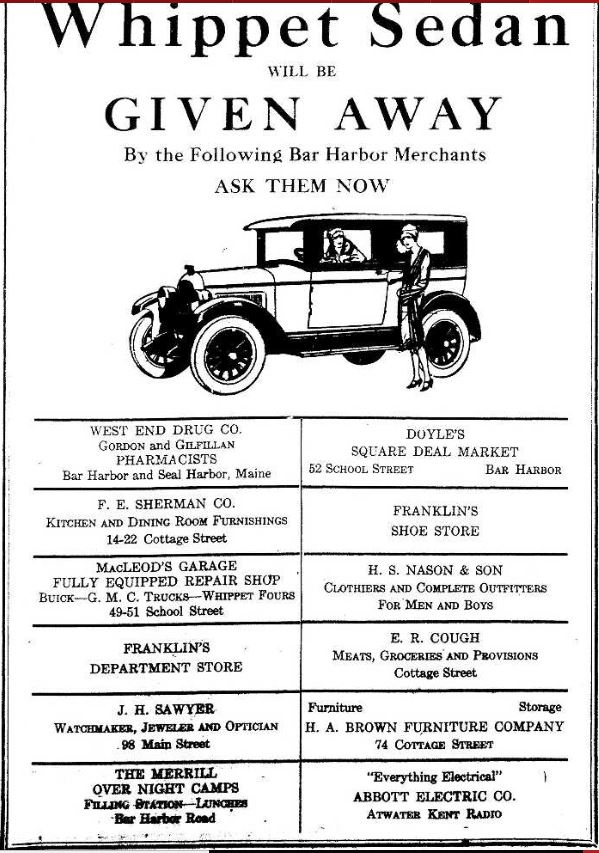
BRAND NEW CAR GIVE-A-WAY
Bar Harbor, Maine


BURRILL NATIONAL BANK
Ellsworth, Maine


L.I. GOTTS CIGARS
Bar Harbor, Maine


TOBIAS L. ROBERTS INSURANCE
Bar Harbor, Maine

HIGH SEA'S, MEADOW BROOK AND THE TITANIC

From the April, 1917, Bar Harbor Times

The death of Prof. Rudolf Ernest Brunnow of Princeton University occurred at his home on Saturday morning of last week, after an illness of only two days with pneumonia. Bar Harbor was deeply shocked at his sudden death, the last in a series of tragedies that have seemed to befall the Brunnow home ever since the handsome villa was constructed here.

Prof. Brunnow was a German by birth and registered as a citizen of Germany. He held some of the highest degrees that it was possible for the German University to bestow and in his own department, that of Semitic lore, he was considered one of the leading authorities in the country.

For the last year or two he had done little active teaching and this season he had spent the entire year at his home in Bar Harbor, which was fitted for year-round occupancy. He was one of the favorite members of Bar Harbor’s summer colony and was deeply interested in the welfare of the town. He was an ardent lover of the walks and trails of his island home and spent many hours traversing the mountain paths here.

Prof. Brunnow’s fine home was built a number of years ago and he intended to bring his bride here. The house, one of the largest, at Bar Harbor, situated near Schooner Head and overlooking the broad ocean and the cliffs at its base, was constructed for their honeymoon. Before they were married, however his bride perished on the ill-fated Titanic, giving up her place to another and older woman. Two families of Bar Harbor’s summer colony were thrown into mourning by the ill-fated steamer.

Another tragedy in Prof. Brunnow’s life was the sudden death of his oldest son, Eric, last fall.

The boy, registered as a freshman at Princeton, left here to begin his studies. On his way he stopped for a night or two in New York with friends and was smitten with infantile paralysis, dying in two days, the grief stricken father having hardly time to reach his bedside.

Prof. Brunnow’s own death came as culminating chapter, owing to an attack of pneumonia which lasted but two days. Funeral services were held at the home, acting rector of Saint Saviour’s officiating.

A thoroughly likable, generous and respected man, Prof. Brunnow will be sincerely mourned by Bar Harbor people, with whom he had made his home, and who regret the dark cloud of tragedy that seems to have followed his last years.


That is pretty much what the local papers went with on the death of Prof. Brunnow, and the bride to be was said to be Edith Evans,  which a number of people claim was nothing more than a close friend of  Mr. Brunnow's and that the two never had plans to marry.  I can't say with any certainty one way or the other if the story is correct, but I will give my reasons for believing it may be wrong as far as Mr. Brunnow's getting married again.  First there is my gut instinct, which tells me the story is wrong.  Than there is the evidence, or lack of.  Where are the newspaper stories or chapters in books attesting to the fact that he was about to remarry, they simply aren't there.  Where are all the newspaper articles referring to the sorrow  Mr. Brunnow was struggling with at the loss of his soon to be bride ?  I searched and could not find one such account, and Mr. Brunnow was a man in high standing in the community, if in fact he had just lost his bride to be, the local papers would of been all over it like flies to honey, and they were not.  And all the people closest to Mr. Brunnow never once made mention of a pending engagement or marriage.  I am sure for one week, that story helped sell many a paper, but I have to conclude no such marriage was in the works.

WHAT IS KNOWN

He was an author of scientific books
He was a master when it came to designing trails
He was a professor
He had High Seas built
High Seas also went by the name Meadow Brook
High Seas was along the Schooner Head Road
His parents were Francis & Rebecca lloyd Brunnow
He was married to Marguerite Beckwith
His wife died in 1907
That same year his 17 year old son died.
Edith Corse Evans was the woman in question
Evans was on the Titanic
Evans was said to have been a good friend of Mr. Brunnow

In 1924, Mrs. Eva Van Cortland Hawkes purchased the mansion for $25,000. Following her death her descendent's gave High Seas to Jackson Laboratory, who continue to use it to this day.

HIGH SEAS - MEADOW BROOK
Prof. Randolph Brunnow
Bar Harbor, Maine


  Now on the debate of rather High Seas was ever called Meadow Brook, on that , I do have a bone in the debate, as it were.  I posted the question on another site and asked, are you certain High Seas was once named Meadow Brook?  The owner of site assured me it was, that if I went back and researched old newspapers, I would see the proof.  Than a family relative came on the site and replied that in fact, High Seas was once named Meadow Brook, and that the family had photos of the estate with the caption written under them, "Meadow Brook."  That should be enough to at least quiet those who insist it never was named that, but lets go back in time, as old newspapers allow us to do from time to time, and see what history has to say on the matter.

BAR HARBOR TIMES
Oct. 1, 1924

Meadow Brook, the estate of the late Dr. R.F. Brunnow, recently bought by Mrs. Morris Hawkes, is one of the large and thoroughly modern Bar Harbor homes.  The residence is of brick as is the garage.  The house was built by the late Dr. Brunnow for his own use and its construction throughout is of the highest type.  There is also a considerable acreage on both sides of Schooner Head Road and from the house one gets a magnificent ocean view.

BAR HARBOR TIMES
June 3, 1925

Mrs. Morris Hawkes of New York is at the Miller Cottage.  Mrs. Hawkes is having extensive alterations made at Meadow Brook, the former Brunnow estate, that she purchased last year.  Mrs. Hawkes will soon take up her residence at Meadow Brook.


BAR HARBOR TIMES
August 12, 1916

Brunnow, Prof. Rudolph E. and family, Princeton, N.J. - Meadow Brook, Schooner Head Road (listed under cottage directory of summer residents).


BAR HARBOR RECORD
August 5, 1914
Brunnow, Prof. R. E. and family - Princeton, N.J. - Meadow Brook, Schooner Head Road.  (listed in Bar Harbor cottage directory)

Now I could of copied dozens of directory listings from month to month, year to year, all stating Mr. Burnnow and family were staying at their cottage  at Meadow Brook on the Schooner Head Road, and there are just as many referring to that same cottage as High seas,  the property, while owned by Mr. Brunnow, went by two names - that much is pretty clear.

THE BATTLE FOR A MONUMENT TO HONOR FALLEN SOLDIERS

Bar Harbor Record
November 6, 1896

Intended For Soldiers Monument Meets With Much Opposition

The committee on citizens and G.A.R. men appointed on the matter of a soldiers monument have decided that a boulder will be the best memorial to commemorate the soldiers who went out from Eden to fight their country's battles,  and to that end they have selected one which lies in a field on the Cromwells Harbor road near the rear entrance to the Kebo Valley grounds.  They have advertised for bids for the removal of the mass of rock to a triangular piece of land given the committee by Mr. C.T. How in Woodbury Park.  Up to the time of writing, no bids have been received by the committee.  The boulder weighs between 80 and 90 tons and is ten feet high, 12 feet long and about as thick through.  The idea of the committee is that after the boulder is placed on the site to fasten a bronze plate on one side of it which will record the names of the brave who fell fighting for their country.  Other accouterments of war, such as pyramids of cannon balls and a few cannon are to be placed about the boulder and the plot of ground surrounding will be graded and turfed.
So far as can be learned, there are but few who favor the plan of having a boulder, which is rather common in this vicinity as the monument to the soldiers for which the town appropriated $2,500 at the March meeting.  There is much opposition to the scheme also among the members of the James M. Parker Post here and it has gone so far that some of the members threaten, in case the boulder is adopted, to resign from the post.  The design is objected to in the first place and than they say that to move a 90 ton rock over 4000 feet would cost nearly as much as the town appropriated for a monument.
One prominent man in speaking of the boulder monument said, "I can not understand how this committee under takes to select a boulder or a monument.  They were simply appointed to select a site for a monument and have no power to do anything further.   At the town meeting a motion was made by William Fennelly that the town appropriate $2,500 for a monument to the soldiers of Eden and later an amendment was passed that the selectmen appoint a number of citizens to act with the G.A.R. to select a site for the monument.  This was done and the joint committee had authority to select a site.  Of course they were expected to report at a regular or special town meeting what they had done  At one special town meeting the Grand Central site was cussed and discussed and there the matter stands as far as the town is concerned.  The monument, as I understand it, is a tribute from the town to the soldiers.  The site having been selected, I should think that the committee's work is done except that they also report progress in having seen designs, estimates, etc. of monuments."
Another citizen said;  "The idea of a boulder as a soldiers monument in a vicinity where boulders are so common, where  in fact they lie on every side, seems to be absurd.  were it in a prairie town or a boulder-less land the idea would be attractive and unique.  then, too, it would be rather difficult to persuade the stranger that this intended boulder monument had been discovered nearly a mile away and that is cost about $2,000 to cart it to its resting place.  The sign 'this is the soldiers monument' might have to be placed nearby.  Why not put a brass plate on Balance Rock and dedicate it to the sailors as well as the soldiers?  It is one of the most famous boulders in New England."
The committee says that they cannot get a suitable soldiers monument for less than $15,000 or $20,000.  It would seem that an artistic monument such as small towns and cities have could be procured for about one-fourth the lowest of the above figures.


THE MEMORIAL ROCK
CROMWELL HARBOR ROAD
Bar Harbor 

The  large boulder above is the only boulder on Kebo Valley Property that stands ten feet tall and twenty feet wide, we believe this was the boulder mentioned in the story.  It is located along the roadside, on a tree lined banking and easy to spot from the road.

GPS from the side of the Cromwell Harbor Road

N 44 22.711
W 068 13.089

From their the massive boulder is but several yards from the roadside by some tree's and can be easily seen.  Walk around to the other side of the boulder for a great photo as the boulder seems to get even larger from the back side.

MR. PINEO'S KENNELS OF BAR ISLAND

August 1, 1900

PINEO'S KENNELS
Rodick's  (Bar)  Island The Home Of Blooded And Costly Dogs.

It is doubtful if many people right here in Bar Harbor realize the magnitude of the business of breeding pointer dogs which is being carried on right under their eyes by Charles B. Pineo at his Bar Harbor Kennels on Rodick's or Bar Island, as it is possibly better known, writes the Bar Harbor correspondent to the Bangor Commercial.
Mr. Pineo has been carrying on this business for many years and started in a small way, by his careful management, fair dealing and successful business methods it has grown steadily until today the Bar Harbor Kennels are said to be the largest devoted to pointer dogs in the world and are well known to every owner of hunting dogs.
The scene is a very interesting one.  There are at present about 200 dogs and puppies in the kennels and their aggregate value is about $10,000.  The dogs have the most ample accommodations.  They are often given the liberty of the island but even when shut up they have plenty of room.  The kennels are right in the woods and are surrounded by trees.
There are several buildings and each dog has a private yard of his own fenced in by wire nettings.  These yards are 30 feet wide and 100 feet deep.  In connection with these yards are boxes which are six feet long, three feet wide and four feet high.  Each of these boxes contain smaller ones which are always kept full of clean straw and which are the sleeping apartments of the canines.
In the matter of food the dogs are not stinted, as a glance at their plump, well conditioned bodies would at once show.


Mr. Pineo purchases in Boston a half ton of dry bread each month.  This bread is gathered from the different hotels and dried until the moisture is out of it, so that it will keep sweet for a long time.  This is fed to the dogs dry and sometimes soaked in water in which meal has been boiled.
The chief article of diet, however, is a sort of a composition food, which is cooked daily.  In the cook house is a large kettle that holds a barrel of water.  This kettle is set in a furnace.  After the kettle is filled with water, fresh meat and bones are put in and boiled until the mixture is cooked, the meat boiled from the bones and the marrow boiled out.  The bones are taken out and the fat  removed from the top of the water.  White wheat is than added to the mixture which is cooked until the wheat is cooked.  When cold this cuts out hard in blocks and forms a food of which the dogs are very fond.  The animals also get fish and corned beef occasionally and have raw meat twice a week in the winter and once a week in the summer.
There are two chief buildings besides the cook house.  One of those is 30 feet square with a hall 10 feet wide running through the center.  On either side of the hall are rooms 10 feet long, and five feet wide, with partitions of which are all of two inch plank.
Each stall or room has a plank door with lock, and each has a box in winter and a bench in summer.  The stalls are heated in winter by hot water pipes.  Back of this building is a yard 100 feet by 200 feet, surrounded by an iron fence six feet in height.  This building is used for the stud dogs and for brood bitches.  The yard is, of course, for affording a place for exercise.
There is another building 100 feet by 120.  This building too is for females and their families.
The pride of the kennels is young Ruip Rap, in 1897 and 1898, the champion pointer of the country, a record which he earned by winning six field trials and defeated all competitors.  He is a son of Champion Rip Rap and his mother was Pearl's Dot, America's most famous pointer bitch.
Young Rip Rap is black and white, well marked, slightly ticked, dark hazel eye, white muzzle, blaze face and black nose.  He is a most powerful dog, deep through the chest, clean throat, good shoulders, strong coupling and good bone.  There is no waste timber about this fellow.  After looking him over carefully, it is no wonder that he ran some of his competitors to a standstill, or that he can run heat after heat in the hot sun in the middle of the day.  Unlike many of the field trial winners he is a show dog.  He has a good muzzle, clean cut head, good ear, well put on, good feet and his muscles stand out like muscles of a race horse.
Young Rip Rap combines in the highest degree the three qualities, high breeding, good form and great field ability.
Rip Rap is a very clever, obedient dog, hunts by hands or whistle.  He is handled by Mr. Gray of Appleton, Minn. who trains many of the dogs from the Bar Harbor kennels.  rip Rap is five years old and at present weighs about 55 pounds,  when ready for field trials he is from five to ten pounds lighter.
Mr. Pineo values Rip Rap very highly and it would require four figures to purchase him should his owner be willing to let him go.  Rip Rap is now earning from $2,000 to $3,000 a year.  When running, he brought home some $1,500 in cash prizes.  The marking most fancied in pointers is white muzzle and blaze in the face extending down over the eyes.
Some of the females bring their owner in from $300 to $500 a year.  From four to ten is an average litter of pups.  Some of the dogs which Mr. Pieno prizes most highly are lghtfield Bang, No. 54.321, Major Jingo, No. 52.047.  the Earl, No. 56.474, Zelia Strideway, No. 42.754, Kittie Gibson, No. 50.425 and Mother Sabine, No. 51.019.

BAR HARBOR ICE BOUND

Bar Harbor Record
February 9, 1918

BAR HARBOR ICE BOUND

Ferry Steamer Disabled - Only Means Of Travel Via Trenton Bridge Over Difficult Roads

Bar Harbor is icebound with the Ferry steamer unable to make trips to the mainland over a course blocked with ice from 18 to 22 inches in thickness.
The Ferry steamer just after leaving the dock at Mount Desert Ferry on Saturday morning, broke the cast iron fans from her propellor while turning in the ice and became locked in the ice about 200 years from the dock.
About 50 passengers were on board, including traveling men and teachers returning from the convention at Ellsworth, and they were put over the side and made their way on the ice to the wharf where they waited until the afternoon train back to Ellsworth and continued their journey to Bar Harbor on sleighs by way of the Trenton Bridge.
Immediately following the accident Capt. Sadler was sent to Rockland to get the steamer Samoset and on Wednesday, accompanied by the Government ice breaker, Favorite, succeeded in clearing Rockland harbor, which is also filled with ice,  and after a hard trip through thick vapor, in which she saw land but once, reached Bar Harbor Wednesday evening.
Thursday morning, the Favorite, which is a Great Lakes steel wrecking tub of about 1000 tons with 1400 horse power engines and has been in these waters only about two weeks, attempted to make a passage to Mt. Desert Ferry.  Owing to the discontinuance of regular trips the channel had become closed and it was only after seven hours she succeeded in cutting a four mile channel through the ice from 18 to 22 inches thick and followed by the steamer Samoset arrived at Mount Desert Ferry.
The Favorite took the disabled Pemaquid in tow and brought her back to Bar Harbor while the Samoset loaded freight at the terminus of the railroad and conveyed it to Bar Harbor a few hours later.
Friday morning the Samoset made the trip through the channel in one hour and ten minutes, which was most favorable, since the regular running time is 45 minutes, and returned to Bar Harbor with a boat load of express.
On attempting to make the afternoon trip, however, she found the channel completely closed, due to shifting winds, and had to put back with her much disgrunted passengers.  The ice breaker Favorite had left during the morning for Rockland where her services were required and it is uncertain when she can return.
Consequently, it looks like a case of wait until the weather conditions change before the boat can continue her trips.  The only means of reaching the mainland is by sleighs via the Trenton Bridge and Ellsworth, a distance of twenty miles, over almost impassable snow drifted roads and mail and passengers are traveling over this route.